How does a hydraulic rotary actuator work? In Eckart’s helical design, oil pressure pushes a piston inside a sealed housing, and helical gears turn that straight stroke into rotation of the output shaft. It turns through a set angle between end stops, gives high torque from a compact unit, and can hold position through a correctly designed load-holding circuit.
A hydraulic rotary actuator does a turning job with a start and a finish: swinging a boom, tipping a load or turning a work platform. This guide explains how Eckart’s helical rotary actuators work, when one beats a hydraulic motor and gearbox, and how to size one. We supply Eckart’s hydraulic range in the UK, from Silsden, West Yorkshire.
How does a hydraulic rotary actuator work? The helical principle
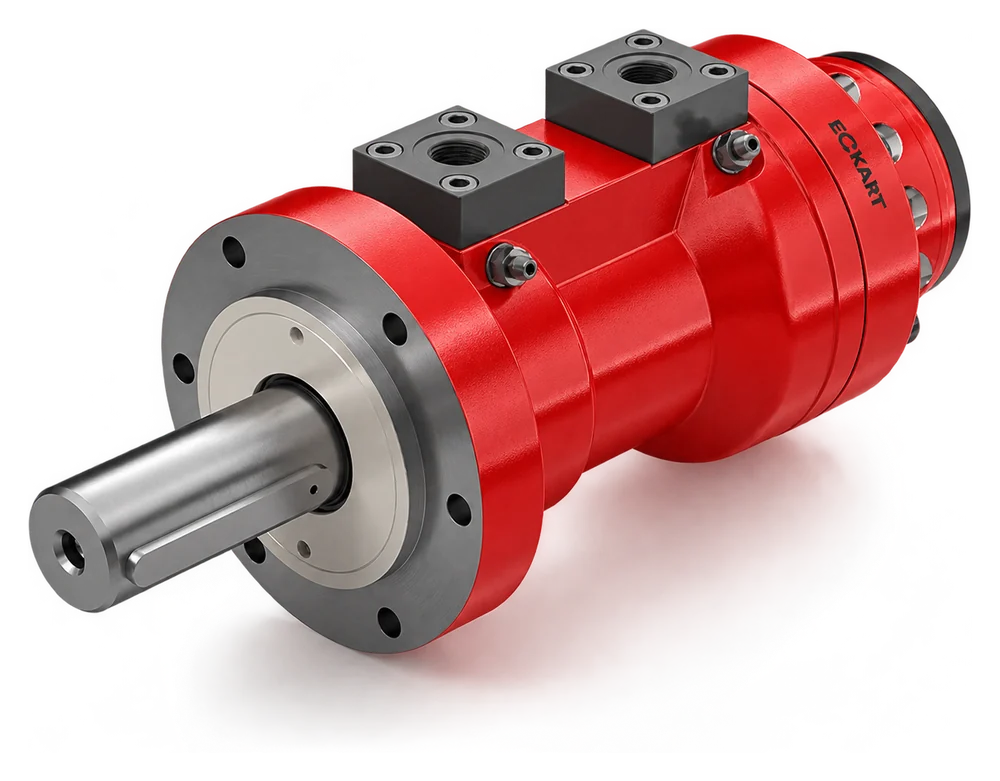
Rotary actuators are built in several ways, including vane, rack and pinion, and helical designs. The Eckart rotary actuator series discussed here use the helical gear principle.
From a straight stroke to rotation
Inside the housing, oil pressure moves a piston between two end stops. On the Eckart SM4, opposed helical gears turn the piston’s straight stroke into rotation of the drive shaft, and the opposed gears double the angle the shaft turns for a given stroke. The result is high torque from a short, compact unit.
Torque in both directions
Pressure on one side of the piston turns the shaft one way, and pressure on the other side turns it back. On the SM4 and E1, torque is the same in both directions.
End stops and cushioning
The rotation angle is set by the end stops. Standard SM4 and E1 angles are 90°, 180°, 270° and 360°, and both can be built to any angle in between or beyond 360°; the E3 turns 180° or 360°. On the SM4 the end stop can be adjusted externally by ±5° as standard, with the actuator depressurised and in the specified end position, and a long-range adjustable stop is an option. Eckart’s end cushioning, an option on the type code, decelerates the load near the end of travel. Its energy capacity and the permitted movement time must suit the load inertia and speed.
How pressure becomes torque
Eckart quotes a specific torque for each size, in newton metres per bar. Use the pressure difference across the actuator for an initial torque estimate, then check the selected size’s ratings, friction, return pressure and duty.
| Actuator and size | Specific torque (Nm/bar) | Torque at 100 bar (Nm) | Torque at 150 bar (Nm) | Torque at 250 bar (Nm) |
|---|---|---|---|---|
| SM4 size 80 | 5.2 | 520 | 780 | 1,300 |
| SM4 size 125 | 21.6 | 2,160 | 3,240 | 5,400 |
| E1 size 80 | 5.88 | 588 | Above the E1’s 100 bar rating | Above the E1’s 100 bar rating |
Size is the piston diameter in millimetres, so a bigger number means more torque. The SM4 runs up to 250 bar and is economical from about 20 bar. The E1 is made for low-pressure systems up to 100 bar. Minimum operating pressure depends on the selected series and version; confirm it alongside the load and return pressure.
Oil volume and speed
Eckart also gives the absorption, the oil the actuator takes per degree of rotation. An SM4 size 80 absorbs 1.323 cm³ per degree, so a 90° turn needs about 119 cm³ of oil. Your pump flow then sets the speed; the permissible turning time also depends on the load inertia and cushioning. Confirm the minimum safe movement time for the selected actuator rather than treating an unloaded catalogue figure as a loaded duty rating.
Holding a load in position
A rotary actuator may need to hold a load as well as move it. Eckart describes the SM4 and HSE4 solid seals as reducing leakage to a minimum. With a suitable load-holding circuit, these actuators can maintain intermediate positions. The complete installation must account for valve leakage, seal condition and fault conditions; low actuator leakage alone does not establish safe load holding.
The SM4’s four-point bearing carries radial and axial loads, and the E3 has bearings for the full load built in, which can simplify a work-platform installation when the applied forces and moments remain within the selected unit’s limits. An E3 valve block can add load holding on an incline, clamping against sideways wobble, and overpressure protection.
Rotary actuator or hydraulic motor and gearbox?
Both turn pressure into rotation, but they suit different jobs. A hydraulic motor keeps turning, often with a gearbox and brake added. A rotary actuator turns through a set angle and stops there.
| Question | Rotary actuator | Hydraulic motor and gearbox |
|---|---|---|
| How far does it turn? | A set angle, such as 90° to 360°, or a special angle | Continuously, in either direction |
| How does it hold a load? | Suitable seals and a correctly designed load-holding circuit maintain position; check leakage and fault conditions | Usually with a brake |
| How is torque delivered? | Directly from one compact unit | Motor torque, multiplied by the gearbox |
| Typical jobs | Tipping, slewing a boom, turning a platform, tool change | Winches, drums, conveyors, wheel and track drives |
If the shaft has to keep turning, read how a radial piston motor works, and our guide to how failsafe hydraulic brakes work for holding the load. If the job has a start and a finish, a rotary actuator is usually the simpler answer.
The Eckart rotary actuators we supply
| Series | Type | Catalogue torque examples (Nm) | Max. pressure (bar) | Motion |
|---|---|---|---|---|
| SM4 | Heavy-duty rotary actuator, 13 sizes | 180 to 85,000 | 250 | 90° to 360°, and beyond |
| E1 | Low-pressure rotary actuator, 6 sizes | 74 to 2,450 | 100 | 90° to 360°, and beyond |
| E3 | Rotary actuator for mobile machines | Up to 3,600 | 210 | 180° or 360°, and any angle between |
| HSE4 | Rotary-linear actuator, 6 sizes | 65 to 2,050 | 100 | Rotation, plus stroke up to 1,200 mm |
| 2AxA | Two-axis actuator | 11,000 and 49,000 by axis, at 210 bar | 250 | 180° and 365° by axis |
- Eckart SM4: heavy-duty rotation under load, with an ATEX option.
- Eckart E1: hydraulics running at 100 bar or less.
- Eckart E3: mobile machines and work platforms, with a through-hole shaft.
- Eckart HSE4: rotation and stroke from one unit.
- Eckart 2AxA and 3AxA: heavy loads in two or three axes.
See the whole range on our Eckart hydraulic actuators page.
The table describes the configurations in the cited catalogues, including the 100 bar HSE4 rotary-linear version. Other versions and larger sizes may differ. Confirm current size, pressure, torque, stroke and mounting together; a range maximum is not a rating for every actuator.
How to size a hydraulic rotary actuator
Start with the job, not the catalogue. We ask for:
- Torque: the torque needed at the shaft, and the pressure available to produce it. Leave a margin for friction, acceleration and pressure losses.
- Motion: the rotation angle, plus the stroke if the job also needs linear movement.
- Loads: the radial and axial forces on the shaft and the bending moment at the mounting.
- Duty: the cycle time, the environment, and any ATEX or SIL requirement.
- Mounting and shaft: flange or foot mounting, and a solid, hollow or DIN 5480 gear shaft or gear hub.
A worked example: a machine needs 2,000 Nm with a 160 bar pressure difference available across the actuator, so at least 12.5 Nm/bar before any margin. An SM4 size 100 (10.8 Nm/bar) gives 1,728 Nm, which is not enough; a size 125 (21.6 Nm/bar) gives 3,456 Nm. The E1 size 125 has more specific torque, at 24.50 Nm/bar, but is rated for 100 bar.
Send us the job, and we will size it
Tell us the torque, pressure, rotation angle and load, and we will size the actuator with you. Replacing one? Send the type code from the type plate and a photo. Email us the details or call +44 (0)1535 655151.
Frequently asked questions
Can a hydraulic rotary actuator turn more than 360°?
Yes. Eckart’s SM4 and E1 come in 90°, 180°, 270° or 360° as standard, and can be built to any angle in between or beyond 360° to order.
Does a hydraulic rotary actuator need a brake to hold a load?
That depends on the load and the machine’s safety requirements. Eckart’s low-leakage seal design can maintain intermediate positions with an appropriate load-holding circuit. Confirm permissible movement, leakage and fault conditions before deciding whether additional mechanical restraint is needed. An E3 valve block can provide load holding and clamping functions.
What pressure does a hydraulic rotary actuator need?
It depends on the series. The E1 is made for systems up to 100 bar, the E3 runs up to 210 bar and the SM4 up to 250 bar, with higher pressures on request. Minimum pressure also varies by version and must be checked for the selected unit.
Do you supply pneumatic rotary actuators?
No. We supply Eckart’s hydraulic range only: rotary, rotary-linear and multi-axis actuators, valve actuators and hydraulic cylinders.
Sources: Eckart SM4 catalogue (production 02/2009); Eckart E1 catalogue (production 10/2007); Eckart E3 catalogue (production 08/2007); Eckart HSE4 catalogue (production 10/2005); Eckart product pages for the SM4, E1, E3, HSE4, 2AxA and 3AxA, opened 14 October 2026. Torques for other pressures are specific torque multiplied by pressure.