How does a radial piston motor work? In a Staffa eccentric-crankshaft design, pressurised oil pushes on pistons arranged like spokes around a central crankshaft, and each piston turns the shaft in turn. A rotary valve times which cylinders take pressure and which return oil to the low-pressure line, so the motor gives high torque from a standstill and runs smoothly at low speed.
This guide explains what happens inside a radial piston hydraulic motor, why it suits slow, heavy duties, how to work out its torque and how fixed and multi-displacement motors differ. The examples use Staffa radial piston motors, which we supply as a UK distributor for Kawasaki Precision Machinery.
How does a radial piston motor work? The working principle
A radial piston motor turns oil pressure into shaft rotation using pistons that sit at right angles to the shaft, pointing out from the centre like the spokes of a wheel.
Pistons arranged like spokes
Each piston runs in its own cylinder, and the cylinders are spaced evenly around the shaft. The number varies with the size of motor: KPM’s spares drawings for the Staffa HMC and HPC list five-cylinder frames, HMC030 to 200 (HPC from 080), and seven-cylinder frames for the 270 and 325.
Pressure turns the shaft
In this Staffa design, each piston bears on an eccentric on the crankshaft. Because the eccentric sits off the shaft centre, the force from a pressurised piston acts to one side of the centre line and turns the shaft. As the shaft turns, the eccentric pushes that piston back up its cylinder, ready for the next stroke.
A rotary valve times the cylinders
A rotary valve, turning with the shaft, decides which cylinders are connected to the pressure line and which to the return line. A piston gets pressure while it can push the shaft round, then the valve switches its cylinder to return as the eccentric drives it back. Several pistons are pushing at any moment and their strokes overlap, which is why the torque is smooth. Swap the pressure and return ports and the motor turns the other way.
Why radial piston motors give high torque at low speed
Radial piston motors are often called low speed high torque (LSHT) hydraulic motors. The reason is displacement: the volume of oil the motor takes for each revolution of the shaft. Radial piston designs carry several large pistons, so displacement per revolution is large. The Staffa HMB runs from 188 to 8,000 cc/rev.
A large displacement means a lot of torque from every bar of pressure, and for a given oil flow the shaft turns slowly. That suits winches, drums, shredders and other drives where a smaller, faster motor would need a reduction gearbox to do the same job.
Staffa motors also use hydrostatic balancing, which KPM says reduces wear and extends service life. For duties below about 10 rpm, or with frequent starts and reversals, the HMB has an increased starting torque option.
Working out torque from displacement and pressure
KPM lists average actual running torque in Nm per bar. Multiplying this by the pressure difference across the motor gives a preliminary estimate. Check the performance curve at the required speed, fluid and return pressure: pump pressure alone is not the pressure available across the motor, and high return pressure can further reduce torque.
| Staffa HMB frame | Displacement (cc/rev) | Running torque (Nm/bar) | Indicative running torque at 250 bar pressure difference (Nm) | Continuous speed (rpm) |
|---|---|---|---|---|
| HMB060 | 983 | 14.5 | 3,625 | 300 |
| HMB100 | 1,639 | 24.3 | 6,075 | 250 |
| HMB200 | 3,087 | 46.07 | 11,518 | 175 |
| HMB325 | 5,310 | 79.4 | 19,850 | 100 |
| HMHDB400 | 6,800 | 101 | 25,250 | 120 |
The bigger the displacement, the more torque and, broadly, the lower the speed limit. Speed itself is set by flow: the inlet flow available after internal leakage, divided by displacement.
Continuous operation must satisfy pressure, speed and power limits together. For HMB maximum intermittent pressure, the duty limit is 15% for up to 5 minutes at 50 rpm or below, and 2% for up to 30 seconds above 50 rpm. Apply the lower pressure limit of the specific frame and fluid. Intermittent power has a separate rating definition.
Fixed, dual and multi-displacement motors
The simplest radial piston motor has one fixed displacement. Others can change displacement while they turn, which gives one motor more than one speed and torque range.
- Fixed: the Staffa HMB, and the HPB for more speed and power from one displacement.
- Two displacements: the Staffa HMC, and the high power HPC. A directional control valve selects the displacement hydraulically. The response to lost control pressure depends on the selected motor, control code and circuit. Confirm it for the exact configuration; a shift to high displacement can be hazardous during freewheeling and is not a substitute for load holding.
- Three displacements: the HMF, with high, medium and low settings. It normally starts in high; a change to medium or low must begin from high.
- Four speeds: the HPC400 has two piston banks, each switched between a high and a low displacement, for 25,000 Nm rated torque from 6,555 cc/rev.
- Infinitely variable: the Smart Motor adds digital displacement control to the HPC200 and HPC325 frames.
At the same flow, the large displacement gives high torque at low speed and the small one gives less torque at higher speed. A winch, for example, can haul a heavy load slowly in high displacement and recover a slack line quickly in low.
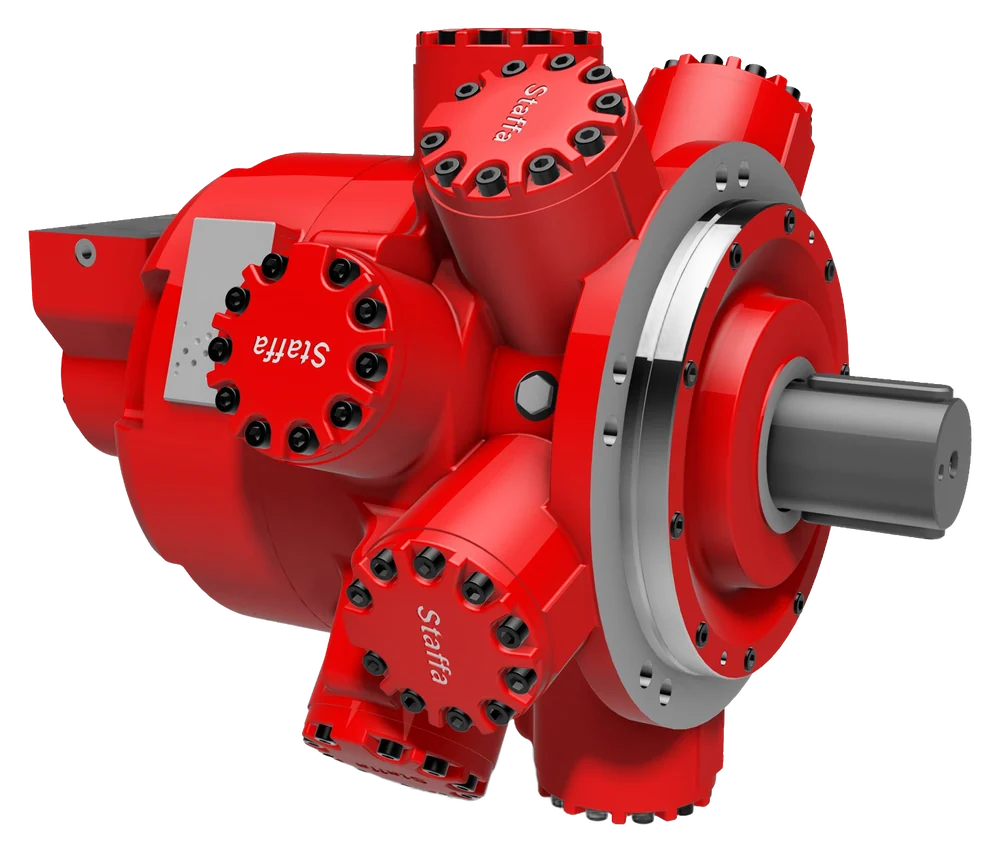
The eccentric-crankshaft explanation above describes Staffa motors; other radial piston designs use different arrangements. Published maxima across a range are not available simultaneously on every motor.
Freewheeling in zero displacement
With a suitable zero-displacement option, Staffa HMC, HPC and HMF motors can freewheel at catalogue speeds up to 1,500 rpm. The exact displacement, boost supply, control pressure, crankcase flushing and duty must meet the selected motor’s specification. Flushing is required above 1,000 rpm, with 15 l/min specified at 1,500 rpm. Freewheeling leaves residual drag and is not controlled lowering or load holding. A fixed displacement HMB can also freewheel, but it pumps substantial recirculating flow and needs a suitable boost and cooling circuit.
Where radial piston motors work
Wherever a machine needs high torque at low speed:
- Marine and offshore: deck and mooring winches, deck cranes, ROV launch systems and pipe handling.
- Recycling, quarrying and tunnelling: shredders, crushers, conveyors and tunnel boring machines.
- Plastics and die casting: injection moulding screw drives and die casting machines.
- Ports and bulk handling: ship loaders, rotating chutes and hatch covers.
Many of these drives must hold the load when the machine stops, which is the job of a failsafe brake: see how failsafe hydraulic brakes work. We make the Staffa brakes that mount directly to Staffa motors.
How to choose a radial piston motor
Start with three numbers from the machine:
- Torque: continuous and peak, at the motor shaft.
- Speed: shaft rpm, and the range if it varies.
- Duty: hours per day, starts per hour and direction changes.
For an initial shortlist, divide the torque you need by the pressure difference available across the motor to find the running torque required, then pick the first frame above it. A drive that needs 11,000 Nm at 250 bar continuous needs 44 Nm/bar, and the HMB200, at 46.07 Nm/bar, is the first HMB frame above that. This is a shortlist, not a final selection. Check starting torque, operating curves, return pressure, shaft loads, speed and power limits, and whether the duty needs more than one displacement or a freewheel.
Replacing a motor that is already in service is simpler: the model code on its nameplate records the frame, shaft, ports and options. Our guide to reading a Staffa motor model code shows how.
Need help choosing or replacing a radial piston motor?
Send us the torque, speed and duty, or the model code of the motor you are replacing, and we will recommend the simplest Staffa motor for the job. Email us your details or call +44 (0)1535 655151.
Frequently asked questions
What is the difference between a radial and an axial piston motor?
Radial piston motors have pistons arranged radially around the shaft; Staffa uses an eccentric crankshaft. Axial piston motors arrange their pistons parallel to the shaft in a swash-plate design, or at an angle in a bent-axis design. The Staffa and Kawasaki M7V ranges illustrate low-speed, high-torque and high-speed duties respectively.
Why is it called a low speed high torque motor?
Because its large displacement per revolution turns each bar of pressure into a lot of torque, while a given flow of oil turns the shaft slowly. That often lets the motor drive a winch drum or shredder directly, without a reduction gearbox.
Can a radial piston motor freewheel?
With a suitable zero-displacement option, Staffa HMC, HPC and HMF motors can freewheel at catalogue speeds up to 1,500 rpm. The exact displacement, boost supply, control pressure, crankcase flushing and duty must meet the selected motor’s specification. Flushing is required above 1,000 rpm, with 15 l/min specified at 1,500 rpm. Freewheeling leaves residual drag and is not controlled lowering or load holding. A fixed displacement motor can also be back-driven with an appropriately designed recirculation, boost and cooling circuit.
Does a radial piston motor need a gearbox?
Often not, because it gives high torque directly at the shaft: up to 25,250 Nm from the HMHDB400 at 250 bar. A Combination Drive pairs a Staffa motor and brake with a planetary gearbox when the required torque, speed, starting duty or packaging makes reduction gearing appropriate.
Sources: Kawasaki Precision Machinery (UK) Staffa datasheets M200112.24-HMB (revised December 2024), M-200203.17-HMC, M-200303.17-HPC, M-200512.17-HMF and HPC400 Cat. No. M-2004/03.26, with the HMC and HPC spares drawing listings on KPM UK’s website.