The open vs closed circuit hydraulic pump choice comes down to where the oil goes. In an open circuit, the pump draws oil from a tank and sends it through valves to cylinders and motors, then back to the tank. In a closed circuit, the pump and motor form a loop, and the pump sets the motor’s speed and direction.
In both circuits the pump is often a variable displacement axial piston pump, where the angle of a swash plate sets how much oil each revolution delivers. What changes is how the pump is plumbed into the machine, and that decides how the machine is controlled and cooled. This guide explains both circuits and where the Kawasaki pumps and motors we supply fit.
How an open circuit works
In an open circuit, the pump’s inlet is connected to the hydraulic tank. The pump draws oil from the tank and delivers it to a bank of directional control valves. The valves send the flow to whichever cylinder or motor needs it, and the return oil goes back to the tank.
Because the pump has to fill itself from the tank, open circuit pump datasheets quote a self-priming speed: the maximum speed under the stated inlet, displacement and fluid conditions. An approved boosted inlet may permit higher speed, within the pump’s separate speed and inlet-pressure limits. The reservoir supports cooling and air separation; correctly specified filtration is still needed to control contamination.
Where open circuits fit
- Machines where one pump serves several functions, such as booms, clamps, rams and auxiliary motors
- Cylinders, which return a different volume of oil from each side and suit a tank-based circuit
- Industrial power units for presses and other plant
Open circuit pumps match their output to demand with controls on the pump itself. Load sensing delivers only the flow the valves ask for, pressure cut-off reduces displacement near its pressure setting, and a torque limiter limits pump input demand. These controls do not replace the circuit’s required pressure protection or safety functions.
How a closed circuit works
In a closed circuit, the pump’s outlet is piped straight to a hydraulic motor, and the motor’s outlet comes straight back to the pump’s inlet. Most of the oil goes round the loop rather than back to the tank.
In a typical reversible closed-loop transmission, the pump controls direction by moving its swash plate through centre. More displacement increases flow and motor speed; crossing centre reverses flow. Auxiliary, isolation and protection valves are still needed as specified by the system design. Controlled deceleration and load holding need their own assessment.
The loop still needs support. Pumps and motors leak a little oil to their cases, which drains to the tank. A charge pump, sometimes called a boost pump, tops the loop back up and keeps its low-pressure side pressurised. Relief valves protect each side, and a flushing valve bleeds warm oil from the loop so cooler oil from the charge pump replaces it.
Where closed circuits fit
- Hydrostatic transmissions, where one pump drives the travel motors of a mobile machine
- Drives that run in both directions and need smooth, stepless speed control
- Loads that can overrun the drive, where the transmission is designed to absorb or dissipate the returned energy and control deceleration
Open vs closed circuit hydraulic pumps compared
| Feature | Open circuit | Closed circuit |
|---|---|---|
| Oil path | Tank, pump, valves, actuator, back to tank | Pump to motor and back, in a loop |
| Direction control | Directional control valves | Typically the pump’s swash plate, through centre |
| Speed control | Valves, with flow matched by pump controls | Pump displacement, and motor displacement if variable |
| Functions per pump | Several | Usually one motor, or a matched set |
| Tank | Larger, holds most of the oil | Smaller, takes case drain and flushing oil |
| Extra parts | Valve bank, return filter | Charge pump, loop relief valves, flushing valve |
| Typical use | Multi-function machines, cylinders, industrial power units | Hydrostatic transmissions and reversing drives |
Kawasaki open circuit pumps
Three Kawasaki series in our range are variable displacement swash plate pumps built for open circuits. Each carries its controls in the model code, so the nameplate tells us exactly how a pump is built.
| Series | Displacement (cc/rev) | Rated pressure (bar) | Peak pressure (bar) | Built for |
|---|---|---|---|---|
| K3VL | 28 to 200 | 320 | 350 | Marine, mobile and industrial machines |
| K3VLS | 50 to 150 | 280 | 350 | Load sensing on mobile machines and industrial vehicles |
| K7VG | 180 and 270 | 350 | 400 | General industrial machinery |
The Kawasaki K3VL axial piston pump is the medium to high pressure choice, in seven sizes, with load sense, pressure cut-off, torque limiting and electric displacement control, and through drives for a second pump. The K3VLS is the compact, lighter pump for medium-pressure mobile hydraulics. The K7VG is the high-pressure pump for industrial plant, with versions for polyol ester, or for water glycol at 210 bar, where the fluid must resist fire.
Kawasaki motors for closed circuits
The Kawasaki M7V variable displacement motor is rated by KPM for both open and closed circuits, and is built for construction machinery and industrial vehicles. Four sizes run from 88.5 to 215 cc/rev at 420 bar nominal and 500 bar maximum, and the smallest reaches 6,150 rpm at reduced displacement.
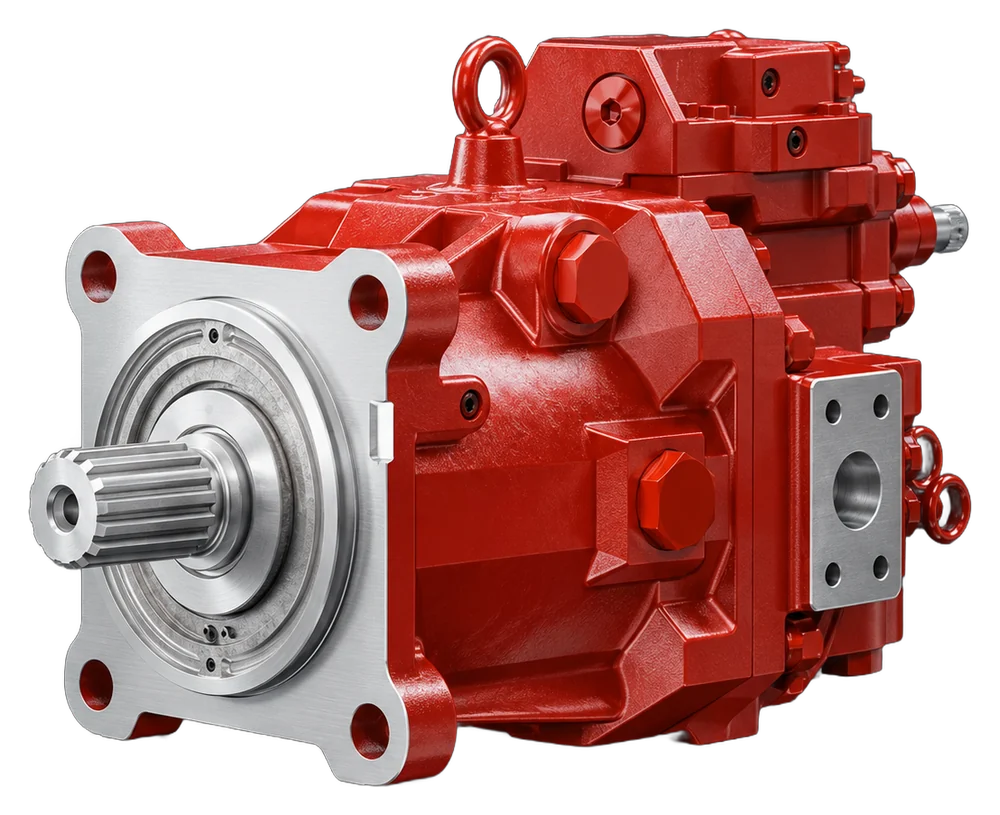
Several M7V options suit a closed loop directly. A flushing valve, with a choice of orifice, takes warm oil out of the loop, and internal cooling supports full-speed running. The minimum displacement can be set down to zero, and two-position, proportional and pressure-related controls change the motor’s speed range on the move. On winches, KPM rules out proportional and pressure-related controls that start at minimum displacement, so tell us the duty and we will specify the right control.
We supply the Kawasaki K8V closed circuit pump as well as the M7V motor. Send the full model code, or the required flow, pressure, speed and control, so we can confirm a suitable pump and motor combination.
Which circuit suits your machine?
- Several functions, or mainly cylinders: an open circuit, with a pump sized for the total flow and controls such as load sense to match it to demand.
- One motor that runs both ways with smooth speed control: a closed circuit, with the pump and motor sized together.
- Very high torque at low speed: look at Staffa radial piston motors, the low-speed, high-torque motors from KPM. Our guide to how a radial piston motor works explains why.
If you are replacing a unit, the circuit is already decided. The model code on the nameplate gives us the series, size, controls and mounting, so we can check compatibility and confirm a suitable replacement.
Need help choosing or replacing a pump?
We are a UK distributor for Kawasaki Precision Machinery, supplying Kawasaki pumps and motors and genuine KPM spares from Silsden, West Yorkshire. Send us the flow, pressure, drive speed and control you need, or the model code from your existing pump, and we will size or match it. See the whole range on our Kawasaki pumps page, or our spares and repairs service. Email us your details or call +44 (0)1535 655151.
Frequently asked questions
Can an open circuit pump be used in a closed circuit?
Not as a rule. Each pump is built for its circuit, and the K7VG model code even includes a digit for the circuit type, 3 for open circuit. Send us the duty or the model code of the pump you have and we will match the right unit.
Does the Kawasaki M7V motor work in open and closed circuits?
Yes. KPM rates the M7V for both. In a closed loop, its optional flushing valve and internal cooling help manage the heat in the circuit, and its displacement controls let it change speed range on the move.
What does the charge pump do in a closed circuit?
It replaces case leakage and oil removed by loop flushing, and keeps the low-pressure side of the loop pressurised. That keeps the main pump fed, and the fresh oil it supplies helps keep the loop cool.
Which Kawasaki open circuit pump should I choose?
The K3VL covers 28 to 200 cc/rev at 320 bar rated. The K3VLS is the compact load-sensing pump for mobile machines, rated at 280 bar. The K7VG is the 350 bar industrial pump. Tell us the duty and we will size it.
Sources: KPM UK K3VL datasheet (MYK6500, 2023); KPM UK K3VLS datasheet (PDC019, February 2022); KPM catalogue K7VG (KPM2021, edition A, November 2020); KPM M7V and M7X catalogue (M7 series, undated). Pressures given in MPa converted at 1 MPa = 10 bar.