Home › Products › Staffa motors › HPC
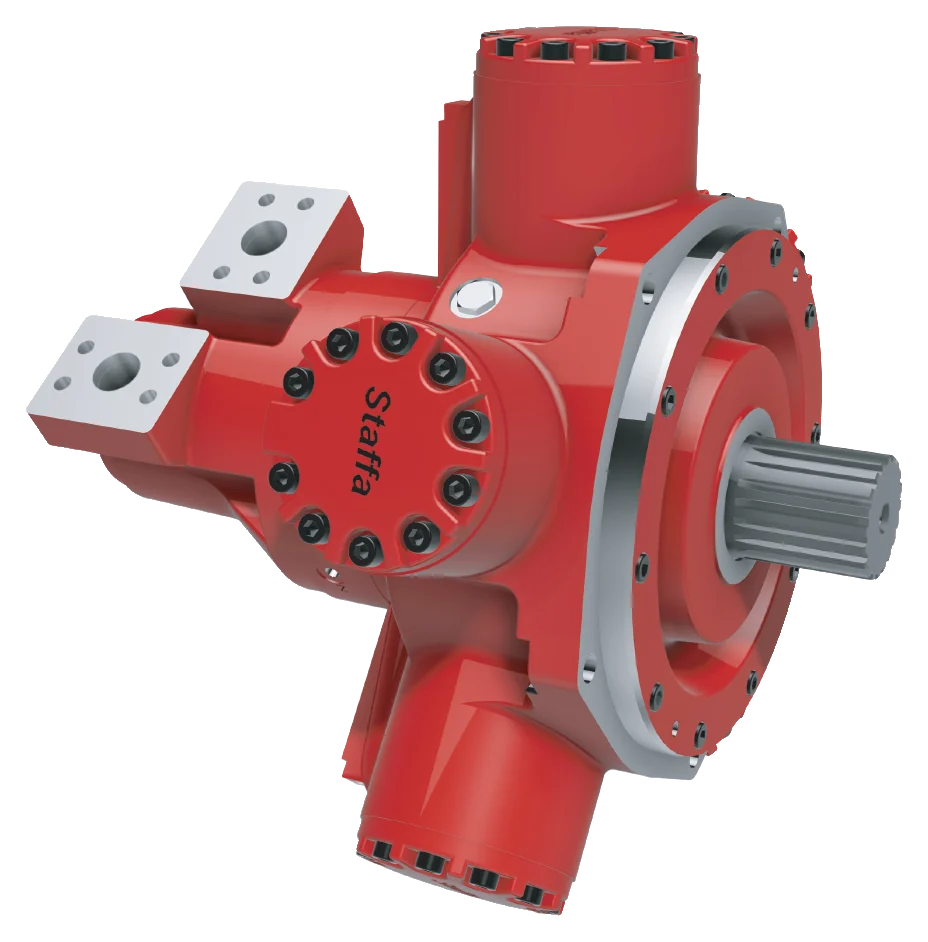
Staffa HPC Dual Displacement Motor
Two displacements at high power.
Home › Products › Staffa motors › HPC
Two displacements at high power.
Five frames to 5,326 cc/rev and up to 278 kW, changing displacement under load. Genuine Kawasaki Staffa motors and spares, supplied and supported from Silsden, West Yorkshire.
278kW
Continuous powerHPC270 and HPC325, with crankcase flushing.
5,326cc/rev
Largest displacementHPC325; the HPC080 reaches 1,600 cc/rev.
2speeds
DisplacementsAny two codes per frame, changed under load.
1,500rpm
Freewheel speedIn zero displacement, with crankcase flushing.
Overview
The Staffa HPC is the high power version of the dual displacement HMC. Low-friction components and crankcase flushing raise its speed and power ratings, and it changes displacement under load, so one motor can cover a heavy, slow duty and a lighter, faster one.
Five frames run from HPC080 to HPC325, with maximum displacements from 1,600 to 5,326 cc/rev and up to 278 kW of continuous shaft power. Displacement is selected hydraulically, a loss of control pressure returns the motor to its high displacement, and zero displacement gives a freewheel at up to 1,500 rpm.
We are a UK distributor for Kawasaki Precision Machinery, supplying HPC motors and genuine KPM spares. The HPC200 and HPC325 frames are also the base of the Smart Motor, and the four-speed HPC400 builds on the HPC range.
Which Staffa motor?
Key advantages
Up to 278 kW continuous with crankcase flushing, across two displacements.
Displacement changes while the motor is turning and loaded.
Low-friction components improve starting and running efficiency and raise back-pressure capability.
Zero displacement for freewheeling at up to 1,500 rpm.
If control pressure is lost, the motor shifts to its high displacement.
Marine paint and cylinder heads, improved shaft seal life, thermal shock resistance. ATEX enquiries are subject to confirmation of the current motor specification and documentation by Kawasaki Precision Machinery.
Technical data
Each frame offers displacement codes from its maximum down to zero, and the motor runs on any two, set in the model code. Figures are at the maximum displacement, with crankcase flushing. Where two figures are shown, the first is with F3 or FM3 housings and the second with F4 or FM4.
| Frame code | Max. displacement (cc/rev) | Running torque (Nm/bar) | Continuous pressure (bar) | Continuous speed (rpm) | Continuous power (kW) | Freewheel speed (rpm) |
|---|---|---|---|---|---|---|
| HPC080Data at 207 bar | 1,600 | 24.1 | 250 | 270 / 365 | 165 | 1,500 |
| HPC125 | 2,048 | 30.8 | 250 | 215 / 300 | 173 / 202 | 1,500 |
| HPC200 | 3,087 | 47.2 | 250 | 175 / 230 | 216261 intermittent | 1,500 |
| HPC270 | 4,588 | 70.1 | 250 | 150 | 278 | 1,500 |
| HPC325 | 5,326 | 81.6 | 250 | 130 | 278 | 1,500 |
Intermittent pressure is 275 bar; the datasheet gives intermittent power for the HPC200 only. Full power and freewheeling between 1,000 and 1,500 rpm need 15 l/min of crankcase flushing. Source: KPM UK HPC datasheet (file M-200303.17-HPC), which lists every displacement code with its torque, speed and power.
Applications
Deck and mooring winches, deck cranes, ROV launch systems, pipe handling
Shredders and waste treatment plant
Crushers and conveyors
Injection moulding screw drives, die casting machines
Tunnel boring machines
Need more than about 25 kNm? A Combination Drive adds a planetary gearbox to a Staffa motor and brake.
Can’t find it?
Send us the model code from the nameplate and we will find the right drawing, CAD model or spares list.
Replacing a motor
Every HPC carries its model code on the nameplate. Send us the full code and we will match the frame, both displacements, the control and the options, or tell you what has replaced them.
An HPC model code carries two displacement codes, such as 250/100, and a control code such as CS. Send us the whole code so we match all of them.
The full model code, a photo of the nameplate, photos of the shaft and port face, and what the motor drives.
We supply genuine KPM spares for HPC motors. Quote the model code, or the part number from the spares drawing. Need a repair rather than a replacement? Call us and we will talk it through.
Model code
Let’s find your motor
We just need three details.
Replacing one? Send us the model code from the nameplate and a photo, and we will work from those.
1
Continuous and peak, at the motor shaft.
2
Shaft rpm, and the range if it varies.
3
Hours per day, starts per hour and direction changes.
Prefer us to call you? Request a callback.
FAQs
Anything else? Call +44 (0)1535 655151 or email sales@advanced-components.com.
Both are dual displacement. The HPC uses low-friction components and crankcase flushing to reach up to 278 kW continuous, against 189 kW for the HMC, with better starting and running efficiency.
For its full power ratings, and for freewheeling between 1,000 and 1,500 rpm, at 15 l/min. Below 1,000 rpm, freewheeling needs no flushing.
Yes. Control pressure must be at least 67% of the higher port pressure, and at least 3.5 bar. If it is lost, the motor shifts to its high displacement.
Yes. The Staffa Smart Motor uses the HPC200 and HPC325 frames with closed-loop electronic displacement control.
Mineral oil as standard. Phosphate ester (HFD) runs with the F3 prefix at the full 250 bar continuous. Water-based fluids (HFA, HFB and HFC) run with the F11 prefix at 103 to 138 bar continuous depending on type, and HFA and HFC at half the mineral oil speed limits.
Our experienced engineers are here to help, no matter what stage you're at. Even if you don't know where to start, we're happy to assist with any project, big or small.